Home / Churches of Florence
This page contains links to all of our articles about Florence's Churches & Cathedrals listed alphabetically:
 Nestled just off Piazza San Firenze, the Badia Fiorentina (usually considered one of oldest churches in Florence) dates its origins back to 978. Around the corner from Palazzo Vecchio and the Uffizi, directly across via del Proconsolo from the Bargello, the abbey's unassuming entryways (one on via del Proconsolo, and one on via Dante Alighieri) "hide" the church from the street (the part of the c... read more.
All new photo album of the church of Santa Croce coming soon! Most of the points on the below map will be included:
From the Opera di Santa Croce:
The Basilica of Santa Croce in Florence was built circa 1294, perhaps by a plan of Arnolfo di Cambio. It was constructed with funding from the population and the Florentine Republic and built above the foundations of a small church which some monks ... read more.
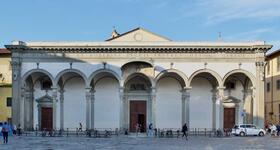 One of Florence's most highly venerated Marian shrines, the Santissima Annunziata was founded in 1250 as the Oratory of Cafaggio by the Seven Holy Founders of the Servite Order. These noble Florentines, following a vision of the Virgin, retired from the city to a hermitage at Monte Senario, north of Florence. The sanctuary's history is intimately connected to a miraculous painting of the Annunciat... read more.
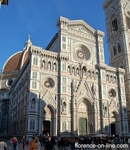 Santa Maria del Fiore, or the Duomo, is the cathedral church of Florence, dedicated to the Madonna of Florence. The basilica is one of the largest churches in Italy and until the modern era, the dome was the largest in the world. It remains the largest brick dome ever constructed. The church's three buildings (including the baptistry and Giotto's tower) form part of the UNESCO World Heritage Site ... read more.
The Certosa del Galluzzo is a hill top monastery just outside of Florence - a short drive (out the Porta Romana and follow the Via Senese), or accessible by bus or taxi. The 37 bus used to service this route, but that route seems to have disappeared from the ATAF website - the 36 looks like the one to take now. You will have to walk up the hill (here is a large image of the route).
The monastery ... read more.
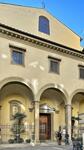 A Hidden Gem of History and Art
Nestled in the Oltrarno district of Florence, just a stone's throw away from the Ponte Vecchio, the Church of Santa Felicita stands as one of the city's most historically and artistically significant churches. Despite its somewhat modest exterior, this church is home to remarkable artworks and has a rich history dating back to early Christianity in Florence. Even ... read more.
A Hidden Gem of History and Art
Nestled in the Oltrarno district of Florence, just a stone's throw away from the Ponte Vecchio, the Church of Santa Felicita stands as one of the city's most historically and artistically significant churches. Despite its somewhat modest exterior, this church is home to remarkable artworks and has a rich history dating back to early Christianity in Florence. Even ... read more.
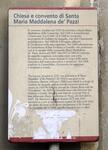 The Church of Santa Maria Maddalena dei Pazzi is a remarkable yet often overlooked gem located on Borgo Pinti in central Florence, Italy. Named after Saint Mary Magdalene de' Pazzi (born Caterina, 1566-1607), a Carmelite nun canonized for her mystical experiences (and perhaps suffering from anorexia, bulimia, and mental disorders), including receiving the stigmata, and her profound devotion to God... read more.
The Great Synagogue (Tempio Maggiore) was built between 1874 and 1882. The architects were Mariano Falcini, Professor Vincente Micheli, and Marco Treves who built the structure in the Spanish-Moresco style.
Layers of travertine and granite alternate create a striped effect on the facade. Old photographs show bold red and beige stripes, but the bold colors of the stone have faded over time, leavi... read more.
 Mass hours for the churches on our Churches of Florence page. This is our best effort on these and the times are pulled from official sources, but can become outdated quickly - so please check with the specific church if you are planning something important!
Cathedral of Santa Maria del Fiore (the Duomo)
Mass Hours Tuesday-Friday: 8:30 a.m., 10 a.m., 6 p.m.Saturday: 8:30 a.m., 10 a.m., 5 p.m.... read more.
Mass hours for the churches on our Churches of Florence page. This is our best effort on these and the times are pulled from official sources, but can become outdated quickly - so please check with the specific church if you are planning something important!
Cathedral of Santa Maria del Fiore (the Duomo)
Mass Hours Tuesday-Friday: 8:30 a.m., 10 a.m., 6 p.m.Saturday: 8:30 a.m., 10 a.m., 5 p.m.... read more.
 The Church of Ognissanti (All-Saints Church) is a Franciscan church founded by the lay order of the Umiliati, a Benedictine order particularly skilled in manufacturing wool.
It was completed during the 1250s, but almost completely rebuilt on the Baroque designs of Bartolomeo Pettirossi, in 1627. Ognissanti was among the first examples of Baroque architecture to be built in Florence.
The Umilia... read more.
The Church of Ognissanti (All-Saints Church) is a Franciscan church founded by the lay order of the Umiliati, a Benedictine order particularly skilled in manufacturing wool.
It was completed during the 1250s, but almost completely rebuilt on the Baroque designs of Bartolomeo Pettirossi, in 1627. Ognissanti was among the first examples of Baroque architecture to be built in Florence.
The Umilia... read more.
One of the most beautiful architectural examples in Florence and a great source of Florentine civic pride, the church and museum of Orsanmichele is a rewarding stop in any itinerary of Florence.
Orsanmichele is known for the sculptures of saints placed in the niches or tabernacles on all four sides of the church by the various guilds of Florence. Executed between 1340 and 1602, they form a time... read more.
This beautiful church was built by the Russian community of Florence which played a signficant role in the development and history of the city. It is officially called the Orthodox Russian church of the Nativity of Christ and Saint Nicholas in Florence.
The church was built between 1899 and 1903 by the talented Russian architect Michail Prà©obraženskij. It has five onion-shaped domes and houses... read more.
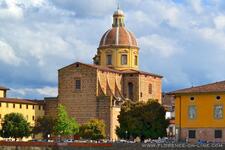 The Church of San Frediano in Cestello is located in the Oltrarno section of Florence. The rough stone façade faces the Arno (with the Piazza del Cestello between the church and the river) and the rear of the church runs along Borgo San Frediano. It is one of the signature landmarks of the Oltrarno and is easily viewed from the opposite bank of the Arno from some distance.
Previously on this site... read more.
The Church of San Frediano in Cestello is located in the Oltrarno section of Florence. The rough stone façade faces the Arno (with the Piazza del Cestello between the church and the river) and the rear of the church runs along Borgo San Frediano. It is one of the signature landmarks of the Oltrarno and is easily viewed from the opposite bank of the Arno from some distance.
Previously on this site... read more.
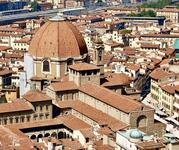 There has been a church on the site of San Lorenzo since 393, making it one of the oldest churches in Florence. The church as it appears now, however, is the result of a renovation begun in 1421 by Giovanni di Bicci de'Medici, who commissioned a new design for the church from Filippo Brunelleschi. This began a relationship between the Medici family and San Lorenzo that lasted for more than a centu... read more.
 San Miniato al Monte is, without argument, the finest Romanesque church in Florence - and the fact that most visitors only make it as far as Piazzale Michelangelo, one switchback below, means you'll often have this hilltop basilica almost to yourself.
The church as it stands today was begun around 1013 under Bishop Ildebrando and largely completed by 1063, funded in part by Emperor Henry II. It's... read more.
San Miniato al Monte is, without argument, the finest Romanesque church in Florence - and the fact that most visitors only make it as far as Piazzale Michelangelo, one switchback below, means you'll often have this hilltop basilica almost to yourself.
The church as it stands today was begun around 1013 under Bishop Ildebrando and largely completed by 1063, funded in part by Emperor Henry II. It's... read more.
Sant'Alessandro a Giogoli is a very interesting looking Romanesque church (12C) on the way from Florence to Montespertoli. It is just off of the SP4 (Strada Provinciale) or Via Volterrana and is surrounded by olive groves. The sign on the front says there is a Ghirlandaio inside, but the church was closed both in the morning and in the afternoon on my way back and forth from Montespertoli to visit... read more.
Allegedly built where Saint Ambrose would have stayed when in Florence in 393, the church dates back to 998 as a chapel of a nunnery built in honour of the saint. It was rebuilt in the 19th century but still has an original open timber roof.
The church contains numerous frescos, altarpieces, and other artwork attributed to Andrea Orcagna, Agnolo Gaddi, Niccolò Gerini, Lorenzo di Bicci, Masaccio... read more.
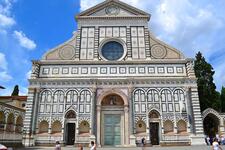 Started in 1221, Santa Maria Novella is chronologically the oldest great basilica in Florence. It was designed by two Dominican friars, Fra Sisto Fiorentino and Fra Ristoro da Campi, and the Dominican order still operate the church. Further work on the basilica continued on commission from Giovanni di Paolo Rucellai who asked Leone Battista Alberti to complete the magnificent façade. The structure... read more.
Santa Maria del Carmine is a church of the Carmelite Order. It is famous for its Brancacci Chapel which houses magnificent Renaissance frescoes by Masaccio and Masolino da Panicale, later finished by Filippino Lippi.
The church, dedicated to the BeatঠVirginis Mariঠde monte Carmelo, began to be built in 1268 as part of the Carmelite convent, which still exists today. Of the original edifice S... read more.
Santa Trìnita (the accent on the first vowel connotes the latin origin of the name) is a Florentine church of the Vallumbrosan Order of monks founded in 1092 by a Florentine nobleman. The church is noted for the Sassetti Chapel (along with many other works), containing notable frescoes by Domenico Ghirlandaio that represent true masterpieces of 15th century art.
The current church was constructe... read more.
 The Basilica of Santa Maria del Santo Spirito ("St. Mary of the Holy Spirit") is located in the Oltrarno quarter of Florence, facing the piazza with the same name. The basilica is a pre-eminent examples of Renaissance architecture.
The current church was constructed over the pre-existing ruins of a 13th century Augustinian convent which was destroyed by a fire in 1471. Filippo Brunelleschi began ... read more.
The Basilica of Santa Maria del Santo Spirito ("St. Mary of the Holy Spirit") is located in the Oltrarno quarter of Florence, facing the piazza with the same name. The basilica is a pre-eminent examples of Renaissance architecture.
The current church was constructed over the pre-existing ruins of a 13th century Augustinian convent which was destroyed by a fire in 1471. Filippo Brunelleschi began ... read more.
It has been difficult at times to find Santo Spirito open during the last few years. Piazza Santo Spirito has a reputation of being a little wild at night, and for awhile the church had completely closed to visitors (there were masses only). The church appears to be open again on a regular basis, and they have a new sign up detailing their hours:
... read more.
Churches of Florence
The churches and cathedrals of Florence hold an infinite amount of treasures. From the world famous Duomo to the smaller churches like Santa Felicita there are so many paintings, sculptures, relics and other things to see in Florence's churches that it would probably take a lifetime to visit them all. In this section we point out both the major and minor, as well as some special "off the beaten" path things to see.
Churches of Florence Map
You can navigate to our individual pages of these Churches & Cathedrals from the links in the below map:This page contains links to all of our articles about Florence's Churches & Cathedrals listed alphabetically:
 Badia Fiorentina
Nestled just off Piazza San Firenze, the Badia Fiorentina (usually considered one of oldest churches in Florence) dates its origins back to 978. Around the corner from Palazzo Vecchio and the Uffizi, directly across via del Proconsolo from the Bargello, the abbey's unassuming entryways (one on via del Proconsolo, and one on via Dante Alighieri) "hide" the church from the street (the part of the c... read more. Basilica of Santa Croce
All new photo album of the church of Santa Croce coming soon! Most of the points on the below map will be included:
From the Opera di Santa Croce:
The Basilica of Santa Croce in Florence was built circa 1294, perhaps by a plan of Arnolfo di Cambio. It was constructed with funding from the population and the Florentine Republic and built above the foundations of a small church which some monks ... read more. Basilica of Santissima Annunziata
One of Florence's most highly venerated Marian shrines, the Santissima Annunziata was founded in 1250 as the Oratory of Cafaggio by the Seven Holy Founders of the Servite Order. These noble Florentines, following a vision of the Virgin, retired from the city to a hermitage at Monte Senario, north of Florence. The sanctuary's history is intimately connected to a miraculous painting of the Annunciat... read more. Cathedral of Santa Maria del Fiore, the "Duomo"
Santa Maria del Fiore, or the Duomo, is the cathedral church of Florence, dedicated to the Madonna of Florence. The basilica is one of the largest churches in Italy and until the modern era, the dome was the largest in the world. It remains the largest brick dome ever constructed. The church's three buildings (including the baptistry and Giotto's tower) form part of the UNESCO World Heritage Site ... read more. Certosa del Galluzzo
The Certosa del Galluzzo is a hill top monastery just outside of Florence - a short drive (out the Porta Romana and follow the Via Senese), or accessible by bus or taxi. The 37 bus used to service this route, but that route seems to have disappeared from the ATAF website - the 36 looks like the one to take now. You will have to walk up the hill (here is a large image of the route).
The monastery ... read more. Chiesa di Santa Felicita, Florence
A Hidden Gem of History and Art
Nestled in the Oltrarno district of Florence, just a stone's throw away from the Ponte Vecchio, the Church of Santa Felicita stands as one of the city's most historically and artistically significant churches. Despite its somewhat modest exterior, this church is home to remarkable artworks and has a rich history dating back to early Christianity in Florence. Even ... read more. Church of Santa Maria Maddalena dei Pazzi
The Church of Santa Maria Maddalena dei Pazzi is a remarkable yet often overlooked gem located on Borgo Pinti in central Florence, Italy. Named after Saint Mary Magdalene de' Pazzi (born Caterina, 1566-1607), a Carmelite nun canonized for her mystical experiences (and perhaps suffering from anorexia, bulimia, and mental disorders), including receiving the stigmata, and her profound devotion to God... read more. Great Synagogue
The Great Synagogue (Tempio Maggiore) was built between 1874 and 1882. The architects were Mariano Falcini, Professor Vincente Micheli, and Marco Treves who built the structure in the Spanish-Moresco style.
Layers of travertine and granite alternate create a striped effect on the facade. Old photographs show bold red and beige stripes, but the bold colors of the stone have faded over time, leavi... read more. Mass Hours for Florence Churches
Mass hours for the churches on our Churches of Florence page. This is our best effort on these and the times are pulled from official sources, but can become outdated quickly - so please check with the specific church if you are planning something important!
Cathedral of Santa Maria del Fiore (the Duomo)
Mass Hours Tuesday-Friday: 8:30 a.m., 10 a.m., 6 p.m.Saturday: 8:30 a.m., 10 a.m., 5 p.m.... read more. Ognissanti
The Church of Ognissanti (All-Saints Church) is a Franciscan church founded by the lay order of the Umiliati, a Benedictine order particularly skilled in manufacturing wool.
It was completed during the 1250s, but almost completely rebuilt on the Baroque designs of Bartolomeo Pettirossi, in 1627. Ognissanti was among the first examples of Baroque architecture to be built in Florence.
The Umilia... read more. Orsanmichele
One of the most beautiful architectural examples in Florence and a great source of Florentine civic pride, the church and museum of Orsanmichele is a rewarding stop in any itinerary of Florence.
Orsanmichele is known for the sculptures of saints placed in the niches or tabernacles on all four sides of the church by the various guilds of Florence. Executed between 1340 and 1602, they form a time... read more. Russian Orthodox Church
This beautiful church was built by the Russian community of Florence which played a signficant role in the development and history of the city. It is officially called the Orthodox Russian church of the Nativity of Christ and Saint Nicholas in Florence.
The church was built between 1899 and 1903 by the talented Russian architect Michail Prà©obraženskij. It has five onion-shaped domes and houses... read more. San Frediano in Cestello
The Church of San Frediano in Cestello is located in the Oltrarno section of Florence. The rough stone façade faces the Arno (with the Piazza del Cestello between the church and the river) and the rear of the church runs along Borgo San Frediano. It is one of the signature landmarks of the Oltrarno and is easily viewed from the opposite bank of the Arno from some distance.
Previously on this site... read more. San Lorenzo
There has been a church on the site of San Lorenzo since 393, making it one of the oldest churches in Florence. The church as it appears now, however, is the result of a renovation begun in 1421 by Giovanni di Bicci de'Medici, who commissioned a new design for the church from Filippo Brunelleschi. This began a relationship between the Medici family and San Lorenzo that lasted for more than a centu... read more. San Miniato al Monte
San Miniato al Monte is, without argument, the finest Romanesque church in Florence - and the fact that most visitors only make it as far as Piazzale Michelangelo, one switchback below, means you'll often have this hilltop basilica almost to yourself.
The church as it stands today was begun around 1013 under Bishop Ildebrando and largely completed by 1063, funded in part by Emperor Henry II. It's... read more. Sant'Alessandro a Giogoli
Sant'Alessandro a Giogoli is a very interesting looking Romanesque church (12C) on the way from Florence to Montespertoli. It is just off of the SP4 (Strada Provinciale) or Via Volterrana and is surrounded by olive groves. The sign on the front says there is a Ghirlandaio inside, but the church was closed both in the morning and in the afternoon on my way back and forth from Montespertoli to visit... read more. Sant'Ambrogio
Allegedly built where Saint Ambrose would have stayed when in Florence in 393, the church dates back to 998 as a chapel of a nunnery built in honour of the saint. It was rebuilt in the 19th century but still has an original open timber roof.
The church contains numerous frescos, altarpieces, and other artwork attributed to Andrea Orcagna, Agnolo Gaddi, Niccolò Gerini, Lorenzo di Bicci, Masaccio... read more. Santa Maria Novella
Started in 1221, Santa Maria Novella is chronologically the oldest great basilica in Florence. It was designed by two Dominican friars, Fra Sisto Fiorentino and Fra Ristoro da Campi, and the Dominican order still operate the church. Further work on the basilica continued on commission from Giovanni di Paolo Rucellai who asked Leone Battista Alberti to complete the magnificent façade. The structure... read more. Santa Maria del Carmine
Santa Maria del Carmine is a church of the Carmelite Order. It is famous for its Brancacci Chapel which houses magnificent Renaissance frescoes by Masaccio and Masolino da Panicale, later finished by Filippino Lippi.
The church, dedicated to the BeatঠVirginis Mariঠde monte Carmelo, began to be built in 1268 as part of the Carmelite convent, which still exists today. Of the original edifice S... read more. Santa Trìnita
Santa Trìnita (the accent on the first vowel connotes the latin origin of the name) is a Florentine church of the Vallumbrosan Order of monks founded in 1092 by a Florentine nobleman. The church is noted for the Sassetti Chapel (along with many other works), containing notable frescoes by Domenico Ghirlandaio that represent true masterpieces of 15th century art.
The current church was constructe... read more. Santo Spirito
The Basilica of Santa Maria del Santo Spirito ("St. Mary of the Holy Spirit") is located in the Oltrarno quarter of Florence, facing the piazza with the same name. The basilica is a pre-eminent examples of Renaissance architecture.
The current church was constructed over the pre-existing ruins of a 13th century Augustinian convent which was destroyed by a fire in 1471. Filippo Brunelleschi began ... read more. Santo Spirito Opening Hours
It has been difficult at times to find Santo Spirito open during the last few years. Piazza Santo Spirito has a reputation of being a little wild at night, and for awhile the church had completely closed to visitors (there were masses only). The church appears to be open again on a regular basis, and they have a new sign up detailing their hours:
... read more. What's New?

Badia Fiorentina
Aug 31, 2026
Festa della Rificolona
Aug 30, 2026
Vinny's Florence Food Walking Tour
Aug 27, 2026
Corri la Vita 2026
Aug 27, 2026