Museums of Florence
A Note Before You Start
Florence's museums could swallow a lifetime. After many years of visiting and living here, I've developed strong opinions about where to spend your time. Take them as exactly what they are: the views of someone who has stood in these rooms for hours. hundreds of times, not a tourist board brochure, or the opinions of a social media influencer who has spent three days here.
Two Museum Passes Worth Knowing About
If you're hitting several major sites, two passes are worth considering:
The Firenze Card
€85 for 72 hours, covering 60+ museums including the Uffizi, Pitti Palace, Bargello, and Accademia. Plenty of visitors love it. If you're trying to pack in as much as possible in three days, it makes sense: skip-the-line access and potential savings. Personally? I think the 72-hour clock creates a kind of museum anxiety that gets in the way of actually seeing anything. But I understand the appeal.
Amici degli Uffizi membership card
My preference for anyone staying a week or more who really wants to get into the renaissance masterpieces is the lesser known Amici degli Uffizi membership card. An annual pass available at Door 2 of the Uffizi that gives you priority, reservation-free entry to the Uffizi and all the Pitti Palace museums. No countdown. No pressure. You can go back to the same room three days in a row if you feel like it — which, in the Uffizi, you absolutely should.
The Non-Negotiables
The Uffizi Gallery
is simply one of the greatest museums on earth. The Botticellis alone — the Birth of Venus and the Primavera hanging in the same room — justify the trip. But the museum is enormous, and the mistake everyone makes is trying to absorb it all in one go. Don't.
With the Amici card, go late in the afternoon an hour or two before closing, when the crowds thin dramatically, and focus on a handful of rooms/works of art at a time.
Two works in particular deserve unhurried attention:
Michelangelo's Doni Tondo — his only surviving finished panel painting — is a circular Holy Family that feels more like carved marble than paint. The colors are almost impossibly vivid five centuries on. Look closely at the nude figures in the background: they echo the famous Laocoön group, excavated in Rome in 1506. That discovery electrified the art world and clearly seized Michelangelo's imagination.
And here's something most visitors walk straight past: the Uffizi has its own Laocoön. At the end of the west corridor stands a marble version carved by Baccio Bandinelli in the 1520s on direct Medici commission — over two metres tall and fascinating in its own right. Bandinelli considered the Vatican original "perfectible" (the ancient sculpture was missing the right arms of the priest and his sons). In his version, he completed them — giving us what he believed the group was always meant to look like.
Before you leave, make your way to the rooftop café on the second floor. The view over Piazza della Signoria and the hills beyond always is fantastic, and the food isn't bad either for a museum café.
The Bargello
This is my other absolute essential — and honestly, the museum I push most when people ask. It occupies an imposing medieval building that was once a prison and the center of local government. Inside it holds some of the most sublime sculpture in Florence: Donatello's bronze David, Michelangelo's Bacchus, and Giambologna's Mercury — a bronze figure balanced on a single toe above a puff of wind from Zephyr below, seemingly about to launch skyward. Walk around it slowly. The pose unfolds differently from every angle.
On almost any day you can walk in without a reservation, and the crowds are a fraction of the Uffizi's. If you love Renaissance sculpture — and after an hour in the Bargello, you will — this is your museum.
A Note on the Accademia (Skip It?)
Here's something I'll just say plainly: the Accademia was never really designed to show the David at its best.
The Tribune — the domed hall built to house it in the 1880s — was an earnest 19th-century attempt to give the statue a worthy home after decades outdoors. But the result is a square room that crowds tens of thousands of people around a 17-foot sculpture with nowhere to step back and breathe. You end up jostling for position a few feet from its base, craning your neck, surrounded by tour groups. The David deserves better.
The replica standing in the Piazza della Signoria — in the open air, at the civic heart of the city where Michelangelo himself placed a version of this work in 1504 — is genuinely a more powerful experience. You can walk around it. See it against the sky. Understand why a young shepherd about to fight a giant needed to stand here, at the center of Florentine public life.
If you do go — and there are reasons to — the real treasures beyond the David are the Prisoners lining the corridor leading to the Tribune: four massive unfinished figures that appear to be struggling to free themselves from the marble. These aren't minor works; they're among the most viscerally moving things Michelangelo ever made.
The painting collection that fills the rest of the museum is largely a teaching collection — the Accademia was originally an art school. Interesting historically but not essential for the general visitor. If your time is limited and you can only visit two of the three major sculpture museums? The Accademia is the one that can give way.
A Little More Obscure - But Worth It
La Specola
This is a gloriously strange museum. A natural history museum with thousands of taxidermied animals, a collection of eerily beautiful 18th-century anatomical wax models, and an amazing collection of minerals. Not for the faint-hearted, but completely unforgettable, the wax models are like nothing else in this world. Children may find the taxidermy absolutely riveting, but some of the was models may need to be viewed by the grownups first (there are some very graphic and realistic sections of the human body and reproductive organs)!
The Palazzo Vecchio archaeological ruins
An often-missed site right in the heart of the city. Most visitors walk past the entrance on their way to the Uffizi without realizing what's underneath. It takes you down through layers of Florence's history, from a Roman theater to medieval remains. Well worth 45 minutes.
The Museum of San Marco
This may be the most quietly moving of all Florence's church museums, a working Dominican convent. Moving through the monks' cells — each one painted with its own Fra Angelico fresco — is unlike anything else in the city.
Museo Galileo
Perfect for science and history enthusiasts. Galileo's telescopes, one of his preserved fingers (yes, really), and a remarkable collection of Renaissance scientific instruments. A perfect counterpoint to an art-heavy week, and genuinely engaging for older children.
A Practical Note
Some of Florence's greatest art isn't in museums at all. A free afternoon in Santa Croce, Orsanmichele, or the Brancacci Chapel will reward you just as richly as any ticketed gallery. Don't forget to look up!
Below you will find all of our individual museum pages:
 Archaeological Museum
The Archaeological Museum was inaugurated in the presence of king Victor Emmanuel II in 1870 in the buildings of the Cenacolo di Fuligno on via Faenza. At that time it only comprised Etruscan and Roman remains. As the collections grew, a new site soon became necessary and in 1880 the museum was transferred to its present building.
The museum houses Etruscan, Roman, Greek, and Egyptian collections... read more. Bardini Museum
Stefano Bardini, an art dealer known for his flair for Renaissance art and his love of blue painted walls, donated his life's labor and the building he housed it all in to the city of Florence in 1922.
The museum houses some of the most unique Renaissance art in Europe. Highlights of the collection include Roman sarcophagi, delicate wooden sculptures, and works attributed to Donatello and Pisano... read more. Bargello Museum
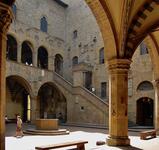 The Museo Nazionale del Bargello has an extensive collection of sculpture from the early and late Renaissance. It occupies an impressive building just off of Piazza San Firenze that was formerly a prison barracks and home to the military captain in charge of keeping peace and justice during riots and uprisings. The Museum holds extraordinary collections of sculpture and minor arts such as ceramics... read more.
 Casa Buonarroti
This museum was a property owned by Michelangelo. The house was converted into a museum dedicated to the artist by his great nephew, Michelangelo Buonarroti the Younger. Its collections include two of Michelangelo's earliest sculptures, the Madonna of the Steps and the Battle of the Centaurs. The museum also houses paintings, sculptures, majolicas and archaeological sections.
The museum is open e... read more. Casa Martelli Museum
The Museum Casa Martelli is an interesting example of an 18th-century nobleman's home and of the family's tastes in collecting.
In 1738 Niccolò and Giuseppe Maria Martelli employed the architect Bernardo Ciurini to transform several houses into the present palace. The interior was decorated in the taste of the period with paintings by Vincenzo Meucci, Bernardo Minozzi and Niccolò Conestabile, and... read more. Certosa del Galluzzo
The Certosa del Galluzzo is a hill top monastery just outside of Florence - a short drive (out the Porta Romana and follow the Via Senese), or accessible by bus or taxi. The 37 bus used to service this route, but that route seems to have disappeared from the ATAF website - the 36 looks like the one to take now. You will have to walk up the hill (here is a large image of the route).
The monastery ... read more. Horne Museum
The Horne Museum takes its name from the English collector Herbert P. Horne (1864-1916) who left his palace and his collections of a lifetime to the Italian State.
This palace had belonged to the Albertis and then the Corsis who gave it its present appearance at the end of the fifteenth century. With its balanced and elegant exterior and its restrained courtyard.
The museum reflects its owner's ... read more. La Specola Museum
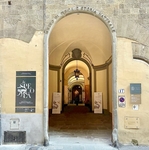 Tucked away in the heart of Florence's Oltrarno district, La Specola stands as one of the city's most fascinating yet underrated museums. While crowds flock to the Uffizi and Accademia, this remarkable institution offers visitors a unique journey through centuries of scientific discovery and artistic craftsmanship that will leave you both amazed, amused, and perhaps slightly unsettled. The museum ... read more.
 Museo Galileo
Update: This museum has been renamed (and reopened after a major renovation) as the Museo Galileo on June 11, 2010.
The (former) Istituto e Museo di Storia della Scienza in Florence is one of the foremost international institutions in the history of science. Founded in 1927, the Museum is heir to a five century-long tradition of scientific collecting, which has its origins in the central importa... read more. Museo Novecento
 The Novecento (Twentieth Century) Museum is dedicated to Italian art of the 20th Century and offers a selection of around 300 works, which are located in 15 exhibition areas, in addition to a study room, a cabinet of drawings and prints, and a room for conferences and projections, as well as special exhibits on a rolling basis. The museum is located in the ancient Spedale of the Leopoldine in Piaz... read more.
 Museum Opificio delle Pietre Dure
The Opificio delle Pietre Dure literally translates to mean Workshop of Semi-precious Stones. It is a public institute of the Italian Ministry for Cultural Heritage based in Florence which is a global leader in the field of art restoration and provides teaching as one of two Italian state conservation schools.
The museum is contained within the workshop. It displays examples of Pietre Dure works... read more. Museum of Palazzo Davanzati
Also known as the Museum of the traditional Florentine house, The Palazzo Davanzati was erected in the 14th century by the Davizzi family, who were wealthy members of a wool guild. In 1516 it was sold to the Bartolini family, and, later that century, to the Davanzati family, who held it until 1838. After the suicide of Carlo Davanzati, it was split into different quarters and modified. After escap... read more. Museum of San Marco
The museum occupies a vast area of the Dominican convent and offers visitors an example of a perfectly preserved 15th century convent, based on the rational and harmonious plan inspired by Bruschelleschi's innovations. The complex also contains the works of Fra' Angelico, one of the greatest artists of the Renaissance. A Dominican monk, he closely collaborated with Michelozzo and his pupils to cre... read more. Museum of the Medici Chapels
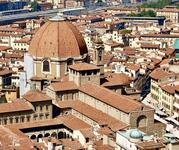 The Medici Chapels form part of a monumental complex developed over almost two centuries to serve as a proper family mausoleum for the Medici family.
Cappella dei Principi, or Chapel of the PrincesMichelangelo began working on the structure around 1520, and until 1533 he worked on the sculptures that wonld have decorated the walls and the sarcophagi. The only ones actually completed were the stat... read more.
The Medici Chapels form part of a monumental complex developed over almost two centuries to serve as a proper family mausoleum for the Medici family.
Cappella dei Principi, or Chapel of the PrincesMichelangelo began working on the structure around 1520, and until 1533 he worked on the sculptures that wonld have decorated the walls and the sarcophagi. The only ones actually completed were the stat... read more. Official Florence Museum Websites
 Official Websites for Florence's Museums: What's Real and What's Not
If you've spent any time searching for Florence museum information online, you've probably noticed how confusing it can be. Multiple websites look official. Some claim to be official while actually being third-party ticket resellers. And the Italian government's own bureaucracy has reorganized itself several times over the past ... read more.
Official Websites for Florence's Museums: What's Real and What's Not
If you've spent any time searching for Florence museum information online, you've probably noticed how confusing it can be. Multiple websites look official. Some claim to be official while actually being third-party ticket resellers. And the Italian government's own bureaucracy has reorganized itself several times over the past ... read more. Opera di Santa Maria del Fiore
The Opera di Santa Maria del Fiore is a lay institution founded by the Republic of Florence in 1296 to superintend the construction of the new Cathedral and the Campanile. As of 1436, the year in which Brunelleschi's dome was completed and the church was consecrated, the principal task of the Opera became that of conserving the monumental complex which was joined in 1777 by the Baptistry of San Gi... read more. Orsanmichele
 Standing on the Via dei Calzaiuoli between the Duomo and Piazza della Signoria, Orsanmichele is one of the strangest and most rewarding buildings in all of Florence. It has been, at various points across a thousand years, a garden (the "Or" in Orsanmichele comes from the word orto - garden in Italian), a Roman temple, a Lombard oratory, a wheat market, a grain warehouse, a miracle shrine, and fina... read more.
 Pitti Palace
The Palazzo Pitti is a grand Renaissance palace built in the second half of the 15th century based on the project of Filippo Brunelleschi and Luca Pitti. Today, it houses several important collections of paintings and sculpture, works of art, porcelain and a costume gallery, besides providing a magnificently decorated historical setting which extends to the Boboli Gardens, one of the earliest Ital... read more. Stibbert Museum
The museum was founded by Frederick Stibbert (1836 - 1906), who was born into a huge inheritance from his grandfather and did not work for the rest of his life. Instead of working, Frederick Stibbert dedicated his life to collecting various objects, antiques, and artifacts and turned his villa into a museum. When the size of the collections outgrew the villa, Stibbert hired architect Giuseppe Pogg... read more. The Vasari Corridor
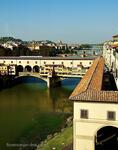 The Vasari Corridor: A Unique Aerial Corridor in FlorenceThe big news in 2025 is that the Vasari Corridor has finally reopened!
The Vasari Corridor has reopened! The Vasari Corridor reopened in late 2024. A combination Uffizi Gallery/Vasari Corridor small group tour is available from Viator. You can also book directly from the official website (B-ticket).Here is a video from the Sunday Morning sho... read more.
The Vasari Corridor: A Unique Aerial Corridor in FlorenceThe big news in 2025 is that the Vasari Corridor has finally reopened!
The Vasari Corridor has reopened! The Vasari Corridor reopened in late 2024. A combination Uffizi Gallery/Vasari Corridor small group tour is available from Viator. You can also book directly from the official website (B-ticket).Here is a video from the Sunday Morning sho... read more. Uffizi Gallery
The Uffizi is one of the oldest and most famous museums in the world and a must-see for any visitor to Florence. Its collection of Medieval and Renaissance paintings comprises several universally acclaimed masterpieced, including works by Giotto, Simone Martini, Piero della Francesca, Fra Angelico, Filippo Lippi, Botticelli, Mantegna, Correggio, Leonardo da Vinci, Raphael, Michelangelo and Caravag... read more. Some links to external websites may be affiliate links (hotel bookings, guide books, activities, etc.). Using these services helps to support our efforts here with no additional costs to the user (you!).